

|
From our newsletters:
|
Eliminating Lawn #1
Eliminating
Lawn #2 Eliminating
Lawn #3
Eliminating Lawn Under a Tree or Around Valuable Plants You
Wish to Keep
Sheet composting under a tarp will not work anywhere within the two-foot
circle outside the drip line of a tree. The high temperatures generated
under a tarp could shock or kill the tree. Most suburban lawns are at
least partly within a two-foot circle of the outside of the drip line
of a tree, so you must use a cold method of sod elimination.
How To:
a. Collect all your newspapers and all your neighbors’
newspapers. For a 20 foot x 20 foot area, a pile around 3 feet high
is not too large.
b. Make the existing vegetation lie flat (trample
it, mow it, string trim it).
c. Fill a large clean open bucket or pan with water.
Unfold each section of newspaper to the size of a single page of newspaper
(but not the size of a double-page spread). You should have a wad of
about 4-8 sheets. (More than 8 sheets over a large area would create
a too thick layer of newsprint, and might smother tree roots, but an
occasional section of 10 sheets won’t hurt anything). Slightly
crumple and dunk each section in the pan until it is really wet. Each
section could take as long as a minute or two to become wet through
to the middle. To speed things up, set some sections soaking as soon
as you take other sections out, or use two buckets.
d. Lay the wet newspaper on the site, overlapping
them by a couple of inches. Because you’re using sections, and
because the sections are wet before you lay them down, they won’t
flap around as dry sheets would. (I blush to think how many years of
waiting for perfectly calm conditions it took for me to figure this
one out.) However, on a windy day, and a 20 foot x 20 foot plot, the
first sections will dry out and might start flapping before the last
are laid, so divide your area into four 5 foot x 5 foot plots, rather
than trying to do the whole thing at once. You can lay the newspaper
right up to the bark of the tree, but you cannot get that close to a
plant—further discussion below.
e. Finish off your work by laying wood chips or bark
nuggets over the newspaper. These serve two purposes. First, the nuggets/chips
hold the newspaper in place until the sod dies of darkness and smothering.
Second, they make it harder for weeds to get going in the resulting
sod-less area. Bark nuggets work a great deal better than wood chips.
Contrary to what you might expect, large nuggets hold off weeds far
better than smaller nuggets or wood chips, and they last a lot longer
too—in my yard the bark nuggets have not been replaced or renewed
in over three years. However, in addition to being (a lot) more expensive
than wood chips, unless you live in lumber-growing territory, nuggets
are a hard-to-find bagged product, rather than a common bulk-delivery
product as wood chips are.
f. Within 2-4 weeks, the unbroken layer of newspapers
will have killed the sod. Push the bark nuggets or the chips out of
the way, and add any desired plants to the landscape though holes dug
through the newspaper, through the now-dead sod and into the earth below,
then re-arrange the wood chips or nuggets to within a few inches from
the crown/stems of the new plantings. Remember than plants want to be
at the same height in the soil as they originally grew, and remember
than the wood nugget/chip layer does not count as part of the soil height,
so set your plants accordingly. If plants are already in the area in
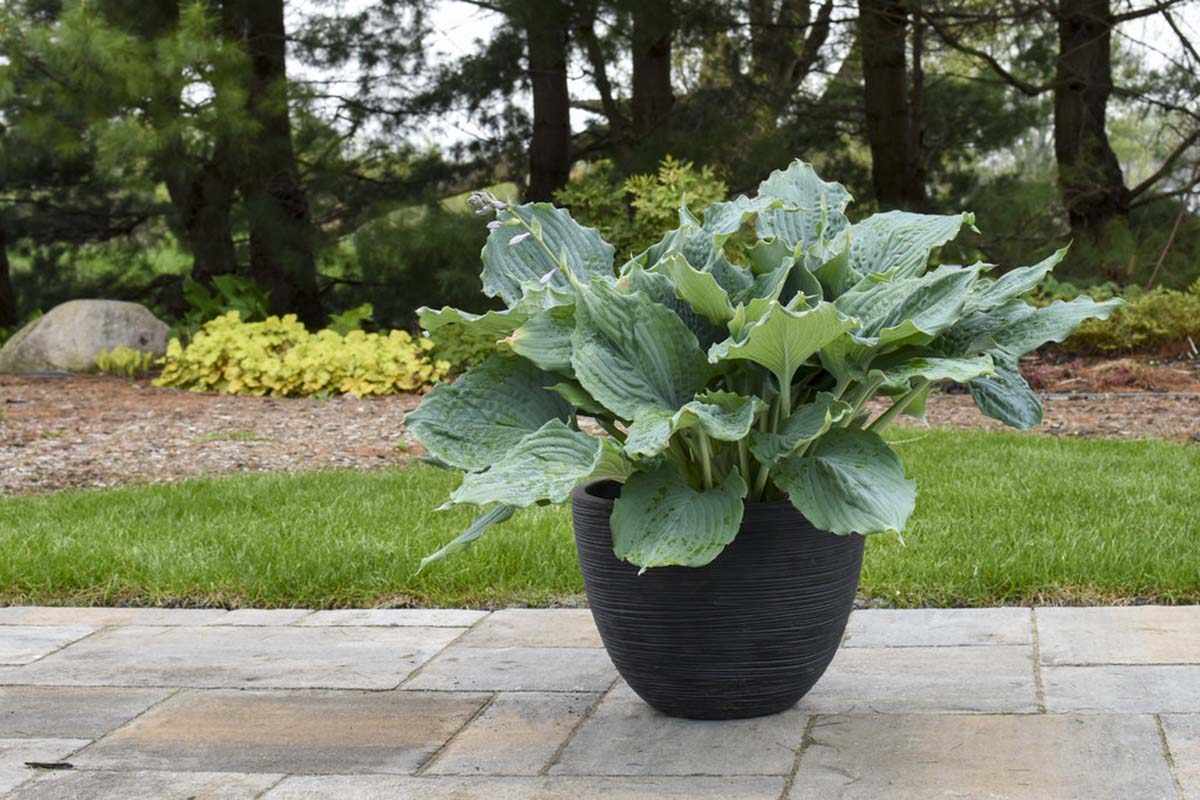
which you wish to eliminate the sod (hostas under a tree, say; or peonies
or other large perennials in a lawn) lay the newspapers in such a way
as to leave 2-6 inches on every side of the plant’s crown or stem
(the bigger the plant, the bigger the area without newspaper). You can
put the bark nuggets or wood chips an inch or two closer to the plant’s
crown or stem than the newspapers are, but not much closer, or you run
the risk of losing the plant to root smothering or mulch-dwelling pests.
g. Water the new plot daily. This helps keep the
newspaper flexible and less prone to tearing (especially if you can’t
keep your kids or dogs off the new plot). Also, the water attracts earthworms
which dispose of the rotting sod that much faster. Worms also decompose
the newspaper, allowing unimpeded air and moisture to return sooner
to the soil surface. In addition, the impact of the watering droplets
settle the nuggets or chips into a better, more even layer.
Why it Works:
Tree roots are remarkably sensitive to level changes. Even a few inches
of fill dirt within the drip line of a tree can smother the roots and
set back or kill a tree. Adding any material at all to the soil under
a tree is risky. Piling mounds of organic matter is a great soil-improvement
idea in the middle of an open field, but under a tree, perform the same
act and you’re asking for root-smothering trouble (plus, mice,
voles and bunnies prefer to live in organic matter right next to the
trunk of a tree) The newspaper method adds very little height to the
soil, and the wood chips or bark nuggets should be used in as thin a
layer as possible. Of course, the further you get away from the trunk
and the nearer you get to the drip line, the less trouble you will cause
by adding a thicker layer of material. Right under most trees, grass
and weeds grow less rampantly anyway, so a thin layer will work better
than you might think. In any event, the newspapers, not the nuggets/chips
are the weed and sod killers at the beginning of the process--only after
the newspaper has decomposed and the sod dies back do the nuggets/chips
act as a weed barrier.
Squirrels will cause trouble by wanting to dig around in your nice
layer of newspapers, and might be pesky enough to actually cause holes
big enough for weeds and sod to thrive. Monitor and patch these holes
with wet newspapers, and push the nuggets or chips back into place over
the patch. In my experience, if you faithfully patch up the holes for
a week or so, the little pests will give up and stop digging around.
Because amending the soil with bulk organic products is not a good idea
under trees, what is best to do for fertilizer/soil amendments? In my
experience, the best soil amendment for trees and the plants under them
are charcoal ashes or wood ashes. A nice dusting in late spring does
a lot of good for the tree, but does not build up the soil as layers
of organic matter would do. The right amount of ashes seems to be the
amount which burns down from 7-10 lbs of charcoal, for each tree big
enough to just fit your arms around, no more than a couple of times
a year, each batch of ashes spread evenly around under the whole area
within the drip line of the tree. Sprinkle water all around to “water
in” the ashes as soon as they are spread—this gets the ashes
off the leaves of plants, and stops the ash dust from blowing around.
Trees don’t like sudden changes of any kind, so wait at least
a month after adding ashes to put down the newspapers, then wait a whole
year to add more ashes. Also, if your tree is a large one, and is in
a stressed position (near a street, or by a sidewalk, or near a pavement
or parking lot of some kind, or where a lot of people walk over its
roots) then you might want to newspaper and mulch under the tree a little
at a time—maybe over the course of three years, doing 1/3 every
year (1/3 in a pie shape, not in concentric rings). The big exception:
in a drought, mulch all the way around, and water, water, water.
Bark nuggets or wood chips take a long time to break down, but they
do break down eventually, as does the newspaper. Within several years,
these breakdowns will have substantially improved the soil within the
dripline of the tree. Although operating on this kind of time line might
make you impatient, you don't want to kill your tree through kindness
by piling its roots with concentrated or faster acting products like
compost, or raw bulk organic materials.
--Gila Shoshany
Madison, Wisconsin, USA
Muriel's comments: I live surrounded by a coniferous
forest. When we dug out our basement we dumped the very sandy soil on
top of fir tree roots, piling the soil right up the trunk - as much
as 4' deep. Perhaps coniferous trees are different...? Or perhaps it
is because the soil was sandy...? But it was thirty years ago and the
trees have never shown any sign of stress from it. |